
 Schedule a Service

Living in Frisco means dealing with blistering 105°F summer heatwaves and unpredictable winter freezes. Your home’s heating and cooling equipment bears the brunt of these extreme temperature swings day in and day out. When efficiency drops, strange mechanical noises echo through the vents, or monthly utility bills suddenly spike, figuring out what is going on becomes a top priority for any homeowner looking into hvac repair frisco.
Understanding how local weather impacts your equipment, recognizing the early signs of mechanical wear, and knowing what a service call actually entails will help you protect your home, control energy costs, and avoid unexpected breakdowns before you ever need emergency hvac repair frisco.
Key Takeaways
- Dual-Season Stress: Frisco’s extreme summer heat and winter cold cycles force HVAC equipment to accumulate massive runtime hours under harsh conditions.
- Early Warning Indicators: Catching minor electrical drifts, restricted airflow, or strange noises prevents catastrophic compressor and heat exchanger failures.
- Rigorous Diagnostics: Professional hvac repair frisco relies on precise multi-meter electrical audits, refrigerant pressure checks, and thermal evaluations.
- Strategic Lifecycle Planning: Evaluating equipment age and cumulative repair costs provides an objective framework for deciding between ongoing repairs and a full system upgrade.
Article Overview
| Topic / Section | Core Technical Focus | Practical Value for Homeowners |
| Why North Texas Weather Tests Equipment | Seasonal thermal stress, runtime hours, and climate demands | Explains why local residential systems wear out faster than average |
| Quiet Warning Signs of Wear | Electrical clicks, short-cycling, burning odors, and utility spikes | Helps identify minor component failures before total system shutdown |
| What Diagnostics Involve | Amperage audits, superheat/subcooling, and static pressure tests | Demystifies what a licensed technician actually measures during a service call |
| Fixing vs. Replacing Your System | Equipment age thresholds, repair cost ratios, and efficiency decay | Guides capital investment decisions when systems reach old age |
Why North Texas Weather Tests Every Inch of Your HVAC System
Unlike homes in temperate coastal regions where heating and cooling demands are mild, North Texas homes subject HVAC units to continuous, heavy-duty abuse. When scheduling hvac repair frisco, technicians often point out that your system operates in two distinct, aggressive operational modes throughout the year:
- The Summer Endurance Test: From June through September, outdoor temperatures routinely exceed 100°F. The outdoor condenser unit must reject heat absorbed from inside the house against a massive thermal gradient, running 12 to 16 hours a day and baking electrical components in superheated attics.
- The Winter Shock Transition: While winters in Frisco are generally short, sudden arctic cold fronts drop temperatures below freezing overnight. Gas furnaces or heat pump reversing valves must transition instantly from months of complete inactivity into high-output heating mode.
This relentless seasonal shift accelerates wear on moving mechanical parts, making regular maintenance and timely hvac repair frisco a necessity for household comfort.
Five Quiet Warning Signs You Need hvac repair frisco
An HVAC system rarely fails without providing subtle advance warnings weeks or months ahead of time. Paying attention to these indicators can save you from an uncomfortable emergency call when you least expect it:
- Short-Cycling Behavior: If your system turns on and off every few minutes without reaching the thermostat setpoint, it is likely tripping a high-pressure safety switch or struggling with a restricted airflow loop that requires professional hvac repair frisco.
- Unexplained Utility Bill Spikes: If your monthly energy consumption increases significantly while your household usage habits remain identical, your system’s efficiency has degraded due to internal mechanical drag or low refrigerant.
- Strange Noises at Startup: Squealing, grinding, or clicking sounds when the blower motor or outdoor compressor engages point to worn belt bearings, failing motor capacitors, or electrical arcing in the contactor.
- Musty or Burning Odors: A stale, earthy smell points to biological growth in the condensate pan, while a sharp burning odor often indicates overheating electrical wiring or dust burning off a neglected heat exchanger.
When these symptoms appear, waiting for the system to quit entirely will only turn a minor component fix into a major overhaul.
What Actually Happens During a Professional hvac repair frisco Visit 🔍
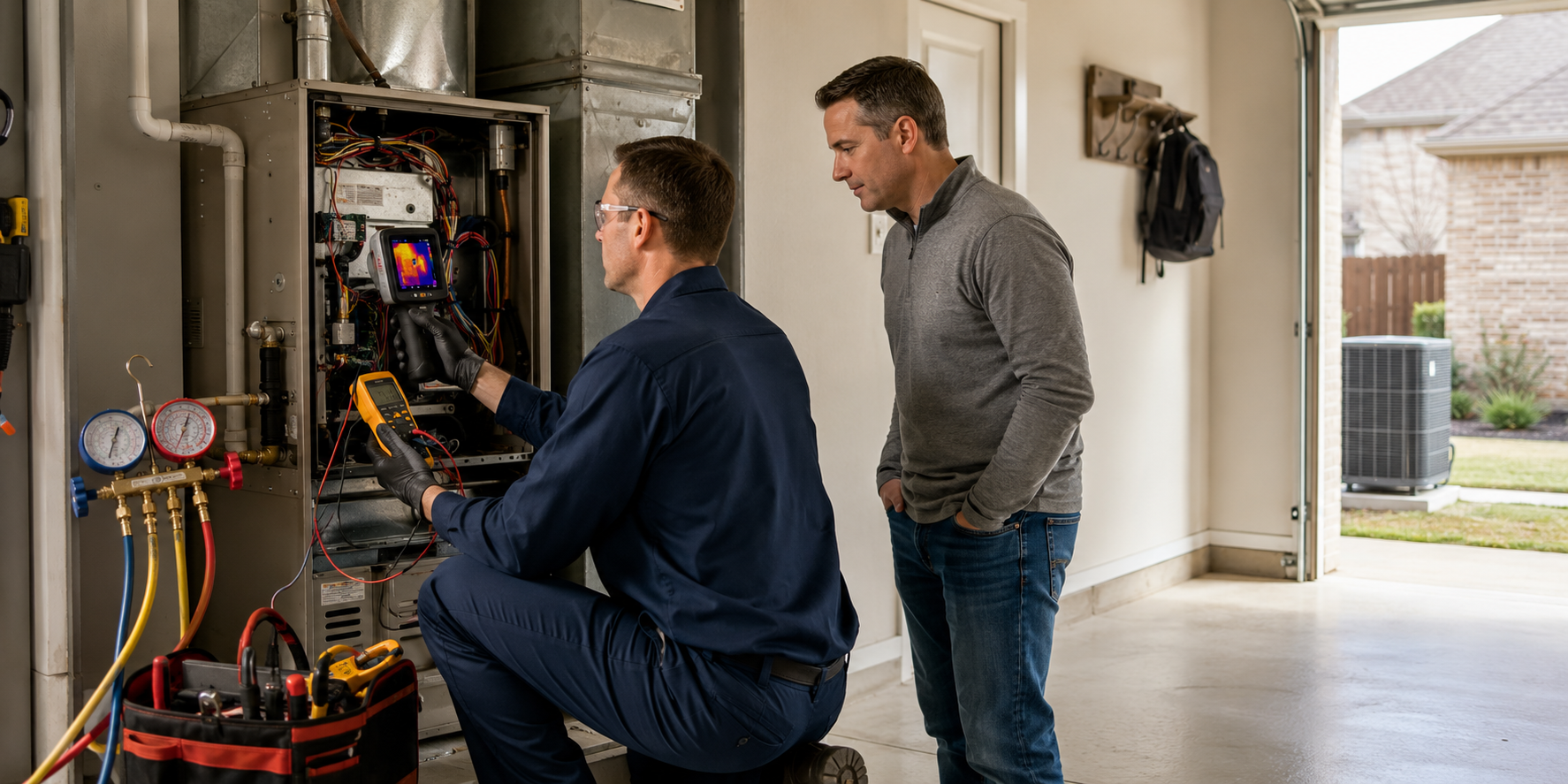
When you call a licensed professional for hvac repair frisco, the diagnostic process should be methodical, data-driven, and transparent. A proper service visit goes far beyond a casual visual inspection:
- Electrical Amperage Testing: Using a true RMS multimeter to measure running load amps (RLA) and locked rotor amps (LRA). If a compressor or fan motor draws excessive current, it indicates internal mechanical resistance or failing windings.
- Refrigerant Circuit Analysis: Attaching digital manifold gauges to measure liquid and suction pressures, calculating exact superheat and subcooling values to verify whether the expansion valve is metering correctly and checking for hidden leaks.
- Static Pressure Evaluation: Measuring total external static pressure (TESP) to ensure your indoor blower motor is moving the correct volume of air against ductwork resistance.
- Combustion & Heat Exchanger Inspection: For heating systems, technicians test gas valve pressures, check burner ignition patterns, and inspect heat exchangers for microscopic cracks that could risk carbon monoxide leaks.
Fixing an Old Unit vs. Replacing It: How to Do the Math Without Panic 📊
Every homeowner eventually faces the dilemma of whether to repair an aging unit or invest in a full system replacement. Industry standards suggest evaluating your equipment through clear financial and operational metrics before committing to major hvac repair frisco:
| Operating Factor | Repair Is the Logical Choice When… | Replacement Is the Strategic Choice When… |
| Equipment Age | The system is under 8 to 10 years old with a documented maintenance history. | The unit has exceeded 12 to 15 years of continuous residential service. |
| Component Integrity | Failed parts are isolated (capacitors, relays, ignitors, or minor switches). | The compressor has suffered burnout, or a gas heat exchanger has cracked. |
| Repair Cost Threshold | Annual repair costs remain under 30% of total replacement equipment value. | Cumulative annual repairs approach or exceed 50% of a brand-new system package. |
| Refrigerant Type | The system operates on modern, eco-friendly refrigerants like R-410A. | The system relies on phased-out R-22 refrigerant, making leak repairs cost-prohibitive. |
Time to Bring Balance Back to Your Indoor Climate? 🚀
Don’t let a struggling system disrupt your household comfort during the next North Texas weather extreme. Whether you need an urgent electrical diagnostic, component replacement, or professional airflow testing, ClassicABC Heating & Air brings 40+ years of Master-licensed field experience (TACLB00005952C) directly to your home. We provide Same-Day Priority Cooling & Heating Dispatch, transparent flat-rate pricing, and a Drop-Cloth Clean Guarantee to protect your living space.
- Claim $25 OFF your initial diagnostic service call.
- Take 10% OFF total repairs for Veterans, Seniors, and Teachers.
Call our local dispatch team right now at 214-310-2665 or email service@classicheatandair.com to schedule your hvac repair frisco service today!
Frequently Asked Questions About HVAC Repair ❓
How often should I schedule professional HVAC maintenance?
You should schedule professional tune-ups twice a year—once in spring before heavy summer cooling begins, and once in autumn before winter heating season. Regular maintenance prevents up to 70% of unexpected mechanical breakdowns.
Why is my HVAC system running constantly but failing to reach the thermostat setpoint?
Continuous running usually indicates restricted airflow (dirty filters or blocked ducts), low refrigerant charge from a leak, or an aging compressor that can no longer build adequate pressure against outdoor heat.
What causes a strange smell when I turn on my heater for the first time in winter?
A mild burning smell during the first heating cycle of the year is usually just dust burning off the heat exchanger elements. However, if the smell is sharp, electrical, or persists for more than a few hours, shut the system off and call a technician immediately.
How do I know if my capacitor is failing before the system stops completely?
If your outdoor fan or compressor hums loudly for a few seconds before tripping a breaker, or if your cooling cuts in and out intermittently on hot afternoons, a failing dual-run capacitor is the most common culprit.