
 Schedule a Service

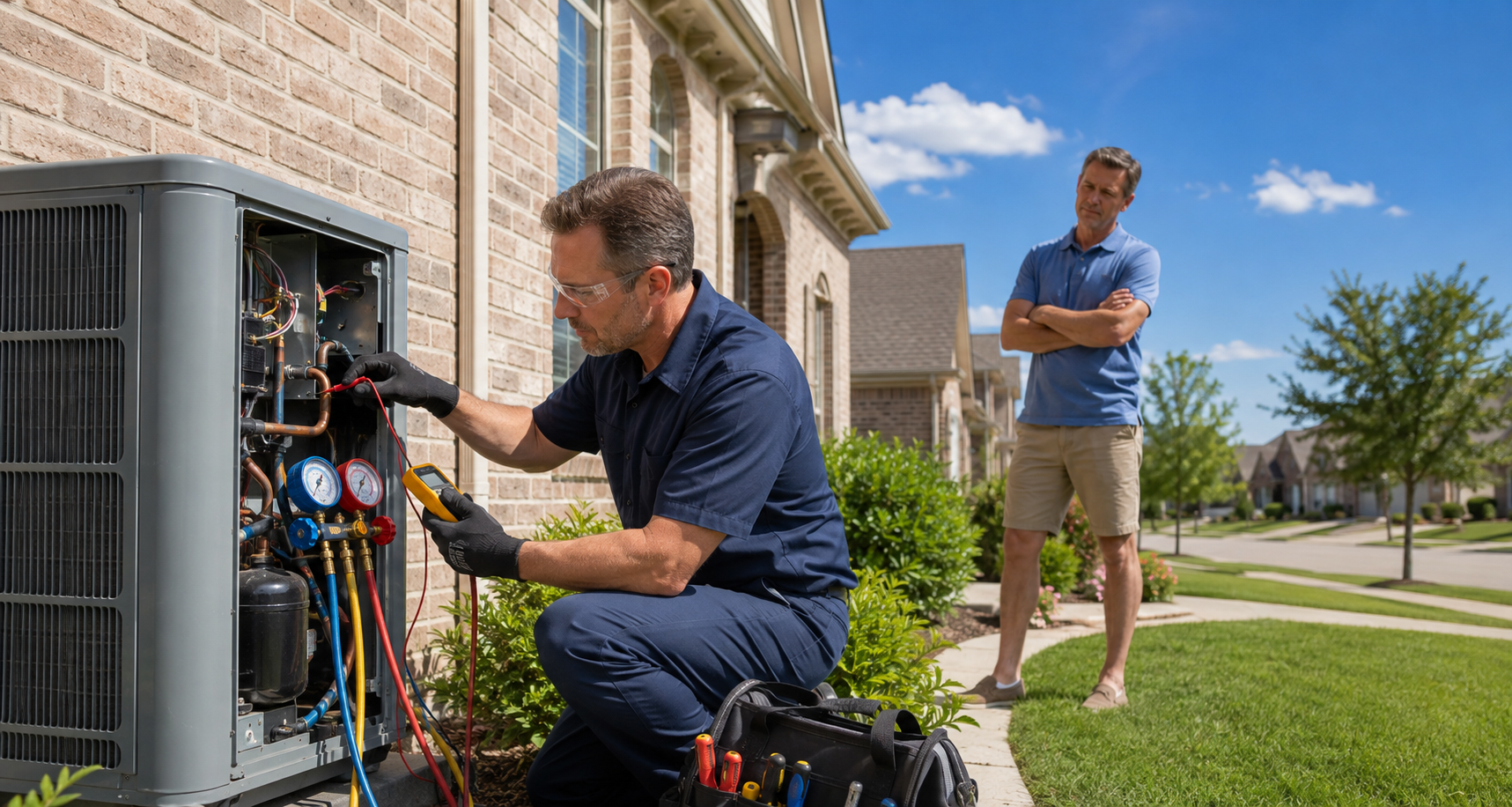
Living in North Texas means enjoying fantastic local culture, vibrant neighborhoods, and weather that tests your home’s infrastructure to its absolute limit. When summer temperatures regularly soar past 100°F, your residential air conditioning system becomes the most important appliance in your house. If you are noticing uneven cooling, strange noises coming from the attic, or rising electric bills, searching for reliable Home AC Repair in Frisco is usually the first step toward restoring comfort and peace of mind.
Understanding how your residential HVAC system works, recognizing early signs of mechanical trouble, and knowing what to expect during a professional service visit helps you make informed decisions to protect your home and investment.
Key Takeaways 🎯
- Continuous Summer Strain: North Texas heat forces residential AC units to run long, demanding cycles, accelerating wear on electrical and mechanical components.
- Early Diagnostics Save Money: Catching minor issues—like a failing capacitor or a restricted air filter—prevents costly mid-summer compressor breakdowns.
- Professional Testing Standards: Reputable repairs rely on rigorous multi-meter electrical audits and refrigerant pressure checks rather than quick guesses.
- Repair vs. Replacement Logic: Evaluating equipment age and cumulative repair costs provides a clear financial roadmap when systems begin to fail.
Article Overview 📋
| Topic / Section | Core Technical Focus | Practical Value for Homeowners |
| Why Frisco Heat Stresses AC Units | High thermal loads, attic temperatures, and runtime demands | Explains why local residential systems wear out faster than in mild climates |
| Common Residential AC Problems | Capacitor failure, refrigerant leaks, dirty coils, and clogged drains | Helps identify what might be going wrong inside your system |
| Safe Homeowner Troubleshooting | Thermostat checks, breaker resets, and filter maintenance | Allows you to safely rule out minor external issues before calling for service |
| What to Expect During Diagnostics | Electrical testing, superheat/subcooling analysis, and airflow checks | Demystifies the professional repair process and ensures technical rigor |
| Home AC Repair vs. Replacement | Equipment age thresholds, repair cost ratios, and efficiency decay | Guides capital investment decisions when systems reach old age |
Why Frisco Homes Put Unique Stress on Residential AC Systems 🌡️
Residential air conditioners in North Texas operate under much harsher conditions than units in cooler regions. While a system up north might coast through mild summers, a home AC in Frisco faces extreme thermal challenges from June through September:
- Relentless Outdoor Temperatures: When ambient outdoor heat hits 100°F or higher, your outdoor condenser unit must reject heat absorbed from inside the house against a massive temperature gradient.
- Superheated Attic Environments: Most traditional Frisco homes place air handlers and ductwork in the attic, where temperatures can easily cross 130°F during peak summer afternoons, baking electrical components and straining blower motors.
- High Daily Runtimes: Local residential units often run 12 to 16 hours a day during peak summer, accumulating massive operational hours in a short three-month window.
Understanding these environmental factors makes it easier to spot when your system is beginning to struggle under the pressure.
The Most Common Residential AC Problems & What Causes Them
Air conditioners rarely fail overnight without warning. Most residential cooling issues stem from a handful of predictable mechanical and electrical failures:
- Blown Dual-Run Capacitors: Capacitors act as heavy-duty electrical storage cells that give your compressor and fan motor the energy boost they need to spin. Intense attic heat degrades these components, causing them to bulge and fail.
- Refrigerant Leaks & Low Charge: AC units do not consume refrigerant. If your system is low on R-410A, it indicates a physical leak in the copper coils or service valves, which starves the evaporator of cooling capacity.
- Restricted Airflow & Dirty Coils: Neglected air filters or dust-choked outdoor condenser coils restrict heat transfer, forcing the compressor to work twice as hard to maintain your indoor temperature.
- Clogged Condensate Drain Lines: Your AC pulls gallons of humidity out of your indoor air daily. Algae and biological growth form sludge in the drain pan, backing up water and tripping safety float switches.
- Worn Blower Motors & Fan Belts: Continuous high-speed operation wears down motor bearings, leading to squealing noises, reduced airflow, and eventual motor seizure.
Before scheduling a service visit, there are a few safe troubleshooting steps every homeowner can perform.
Safe Homeowner Troubleshooting Before Calling for Service 🛠️
If your home feels warmer than it should, take ten minutes to check these basic external factors before picking up the phone:
- Verify Thermostat Settings: Ensure the system is switched to COOL and the fan is set to AUTO. Sometimes simple battery replacements or accidental setting changes are the only culprits.
- Check the Main Breaker Panel: High electrical draws can trip the double-pole breaker dedicated to your HVAC unit. Flip it firmly to OFF and back to ON once. If it trips instantly, stop—you have an electrical short.
- Inspect and Replace Your Air Filter: A clogged, gray filter chokes off return air, dropping static pressure and causing your indoor coil to freeze solid. Swap it out with a clean filter immediately.
- Clear Debris Around the Outdoor Unit: Ensure bushes, grass clippings, and children’s toys are cleared at least two feet away from your outdoor condenser to allow proper airflow.
If these checks do not restore cool airflow, the problem requires professional technical diagnosis.
How Professional Duct Sealing Lowers Your Monthly Cooling Bills 📉
Many homeowners invest in high-efficiency air conditioners, unaware that up to 20% to 30% of the conditioned air produced by the system is escaping into the attic through duct leaks before it ever reaches a vent.
When supply ducts leak in a hot attic, you are literally paying to cool your roof deck. Furthermore, return duct leaks pull hot attic air straight into your indoor air handler, overwhelming the evaporator coil with high-humidity air. Sealing duct joints with mastic paste, reinforcing connections with heavy-duty metal clamps, and insulating exposed runs restores proper static pressure, balances indoor temperatures, and gives your air conditioner a well-deserved break.
Navigating MERV Ratings: Choosing the Right Filter Without Choking Your Blower 🛡️
When homeowners want better indoor air quality, they often grab the thickest, most restrictive HEPA-style filter off the hardware store shelf. While these filters capture microscopic particles, they can cause unexpected mechanical trouble:
- The Airflow Restriction Trap: Residential HVAC blowers are engineered to operate within specific static pressure ranges. A hyper-restrictive filter chokes off return air, dropping static pressure and potentially freezing your indoor evaporator coil.
- The Sweet Spot (MERV 8 to MERV 11): For most residential homes in Frisco, a high-quality pleated filter with a MERV rating between 8 and 11 offers the ideal balance of capturing household dust, pet dander, and pollen without suffocating the blower motor.
- Deep Filtration Systems: If you want hospital-grade filtration (MERV 13+), consult a technician to install a dedicated media air cleaner cabinet. These oversized filters provide massive surface area, capturing microscopic pollutants without restricting airflow
Stop Letting Your Attic Feed Your Family Dust: Let’s Clear the Air
Don’t let hidden duct leaks, sagging flexible lines, and trapped attic debris compromise your family’s health and comfort. (And unlike the previous boilerplate, this isn’t just about a broken compressor—it’s about the air you breathe every second). Whether you need a precise duct pressurization test, professional sealing, or expert indoor air quality consulting, ClassicABC Heating & Air brings 40+ years of Master-licensed field experience (TACLB00005952C) directly to your home. We provide thorough evaluations, transparent flat-rate pricing, and a Drop-Cloth Clean Guarantee to protect your living space.
- Claim $25 OFF your initial diagnostic or service visit.
- Take 10% OFF total repairs for Veterans, Seniors, and Teachers.
Call our local dispatch team right now at 214-310-2665 or email service@classicheatandair.com to schedule your air duct and indoor air quality consultation today!
Frequently Asked Questions About Home AC Repair ❓
How often should I schedule professional maintenance for my home AC?
You should schedule professional tune-ups twice a year—once in spring before heavy summer cooling begins, and once in autumn before winter heating. Regular maintenance prevents up to 70% of unexpected breakdowns.
Why is my AC running constantly but failing to cool my house?
Continuous running usually indicates restricted airflow (dirty filters or blocked ducts), low refrigerant charge from a leak, or a failing compressor that can no longer build adequate pressure.
What causes ice to form on my indoor AC unit?
Ice forms when restricted airflow or low refrigerant causes the evaporator coil temperature to drop below 32°F, freezing ambient moisture on contact. Turn your system off and call a technician to thaw and inspect the unit.
How do I know if my AC capacitor is failing?
If your outdoor fan or compressor hums loudly but fails to start up, or if your cooling cuts in and out intermittently, a failing dual-run capacitor is the most common culprit.