
 Schedule a Service

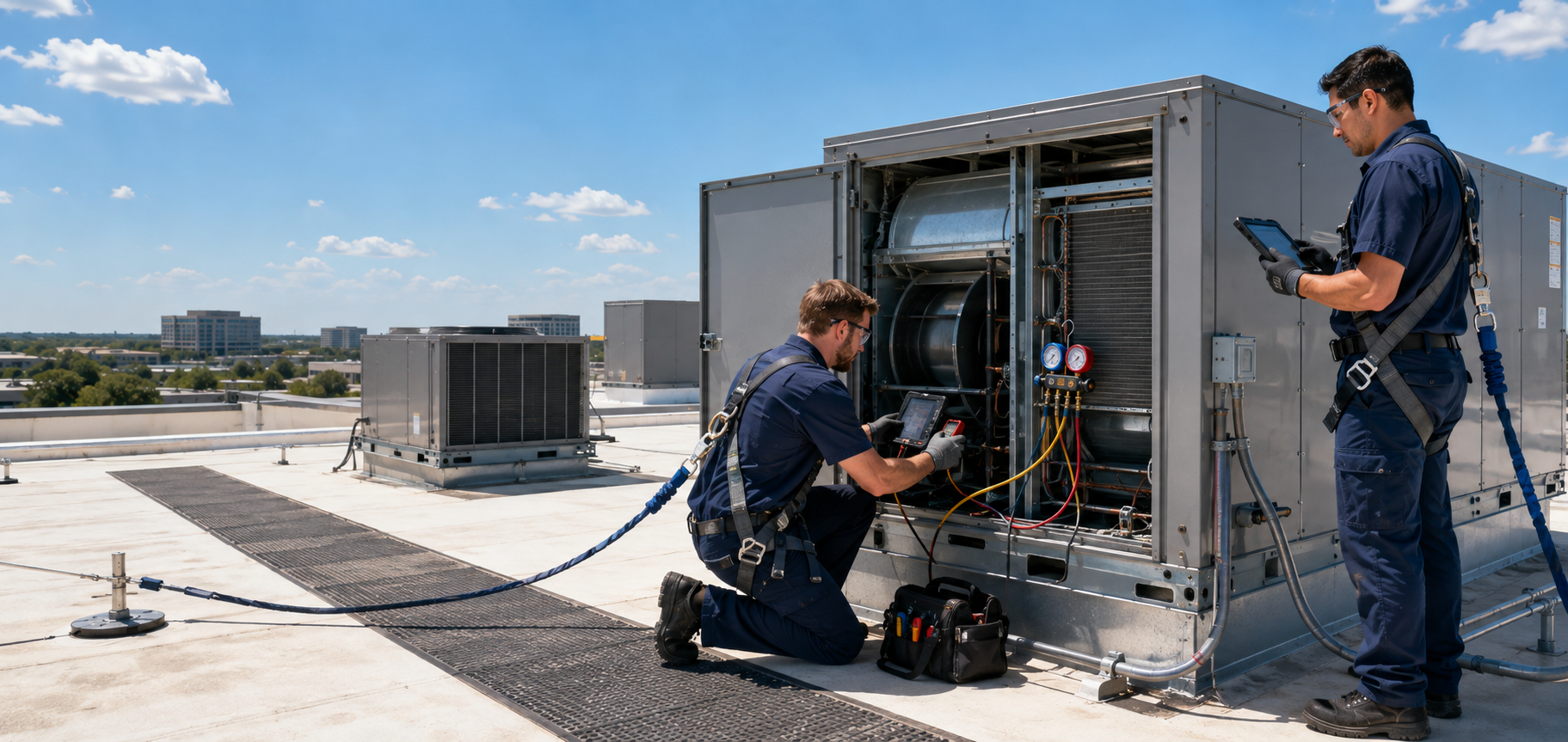
Maintaining a stable indoor climate with a commercial AC in Frisco, TX during a North Texas summer is a demanding engineering challenge. When outdoor temperatures push past 100°F, commercial air conditioning systems must contend with continuous solar heat gain, high foot traffic, heat-generating office equipment, and strict ventilation mandates. An underperforming cooling system leads to elevated humidity, fluctuating temperatures, and steep increases in monthly utility bills.
Understanding facility cooling requires looking beyond routine thermostat adjustments to the engineering and financial realities of commercial HVAC management. This guide breaks down what it takes to keep your building cool, compliant, and cost-effective—giving you the practical insights needed to protect system performance and avoid unexpected operational downtime.
Key Takeaways
- Dynamic Heat Loads: Commercial systems manage both sensible heat (air temperature) and latent heat (humidity) driven by occupancy and equipment.
- Proactive Maintenance: Economizer calibrations and coil cleanings reduce compressor head pressure and prevent summer utility spikes.
- Capital Cost Modeling: System age, 50% cumulative repair thresholds, and IEER metrics dictate when replacement beats ongoing repair.
- Static Pressure Control: Balancing duct static pressure and multi-zone dampers prevents hot spots across diverse facility layouts.
Article Overview
| Section | Core Focus | Practical Value |
| Commercial vs. Residential AC | RTU packaging, tonnage staging, and economizer mandates | Clarifies why commercial setups require specialized engineering |
| Thermal & Mechanical Demands | Sensible/latent loads, duty cycles, and fresh air codes | Explains physical stress factors causing equipment wear |
| Early Indicators of Stress | Head pressure spikes, short-cycling, and static pressure drops | Helps catch minor component drift before system breakdown |
| Repair vs. Replacement Cost | Equipment age, IEER decay, and the 50% cost rule | Establishes an objective framework for capital expenditure |
| Diagnostic Protocols | Superheat/subcooling, static pressure, and amperage audits | Details exact testing parameters used to verify system health |
| Layout Airflow Strategies | Zone balancing, makeup air (MAUs), and VRF configurations | Connects mechanical design directly to building architecture |
| Texas Efficiency Standards | ASHRAE 62.1, IEER mandates, and A2L refrigerant shifts | Outlines legal and environmental standards for commercial units |
Why Commercial AC Systems Differ from Residential Units 🏢 vs. 🏡
Treating a commercial property like an oversized home leads to short-cycling and humidity issues:
- Packaged Rooftop Units (RTUs): Commercial systems consolidate compressors, coils, and blowers into single rooftop cabinets to preserve interior space.
- Modular Tonnage Staging: Systems ranging from 10 to 50+ tons distribute load across multiple independent compressors that stage based on real-time occupancy.
- Fresh Air & Latent Load: Building codes mandate motorized economizers to pull in outside air continuously, introducing heavy humidity the system must actively wring out.
- Multi-Zone Controls: Systems use VAV boxes, motorized dampers, or Variable Refrigerant Flow (VRF) setups to manage dozens of distinct temperature zones simultaneously.
Thermal Loads & Mechanical Demands in Commercial Buildings
Unlike residential units, commercial systems modulate volume continuously against dynamic internal loads:
- Occupancy Spikes: Sudden crowds in conference rooms or retail floors introduce thousands of BTUs of human heat instantly.
- Internal Equipment Heat: Server racks, computers, lighting, and kitchen appliances dump continuous ambient heat into the evaporator coil.
- Latent Dehumidification: Moisture from foot traffic and ventilation mandates requires long cooling cycles to prevent sticky indoor humidity.
Early Indicators of Mechanical Stress in Commercial Units ⚠️
Catching component drift early prevents severe compressor burnout:
- Zone Temperature Imbalances: Uneven temperatures signal static pressure drops, stuck dampers, or duct leaks.
- Rooftop Unit Short-Cycling: Brief 2-to-3-minute bursts usually indicate high head pressure cut-outs caused by dirty condenser coils or failing fan motors.
- Plenum Noise & Vibration: Squealing or grinding from vents points to slipping blower belts, worn bearings, or unbalanced blower wheels.
- High Amperage Draws: Spiking electric bills indicate compressors drawing extra amperage to overcome internal mechanical drag.
- Condensate Overflows: Ceiling water stains signal clogged primary drain lines, failed condensate pumps, or tripped float switches.
Commercial AC Repair vs. Replacement Cost
Facility managers rely on the 50% HVAC Rule: if cumulative annual repair quotes reach 50% of a new system’s cost—or if a unit is over 12 years old and running on phased-out R-22—replacement is the smarter capital move.
| Operating Benchmark | Repair Is Logical When… | Replacement Is Strategic When… |
| Equipment Age | Under 8–10 years old with clean service history. | Exceeds 12–15 years of continuous commercial service. |
| Refrigerant Type | Operates on modern R-410A or eco-friendly refrigerants. | Uses phased-out R-22, making leak recharges cost-prohibitive. |
| Cumulative Repair Costs | Annual repair quotes remain under 30% of system value. | Annual repair costs approach or exceed 50% of new equipment. |
| Seasonal Efficiency (IEER) | Maintains rated IEER without electric demand spikes. | Efficiency has degraded, causing monthly demand charges to surge. |
| Compressor Health | Normal electrical resistance and clean system oil. | Grounded windings, mechanical burnout, or acid contamination. |
Technical Diagnostic Protocols 🔍
Assessing commercial system health requires systematic testing:
- Static Pressure Testing: Digital magnehelic gauges measure Total External Static Pressure (TESP) against fan curves to locate duct restrictions.
- Refrigerant Cycle Analysis: Digital manifold gauges calculate superheat and subcooling to verify TXV metering and thermal transfer.
- Electrical Load Audits: True RMS multimeters measure running load amps (RLA) and voltage drops to detect pitted contactors or failing capacitors.
- Economizer Calibration: Outdoor air dampers and enthalpy sensors are tested to ensure proper modulating “free cooling” during mild weather.
Airflow Distribution Across Commercial Layouts 🏬
Architectural floor plans dictate conditioning strategies:
- Retail Layouts: High foot traffic requires high-velocity ductwork and air curtains near entrances to maintain a thermal barrier.
- Restaurants & Kitchens: Exhaust hoods create negative pressure, requiring dedicated makeup air units (MAUs) to balance supply air.
- Office Buildings: VRF or VAV setups modulate dampers independently to suit individual room occupancy.
- Warehouses: HVLS fans combined with heavy-duty RTUs prevent heat stratification near high ceilings.
Texas Building Codes & Efficiency Standards 🏛️
- IEER & SEER2 Compliance: Codes enforce strict Integrated Energy Efficiency Ratio (IEER) ratings on packaged equipment to regulate peak grid demand.
- ASHRAE 62.1 Mandates: Motorized economizers automatically adjust outdoor air intake based on occupancy and $CO_2$ levels.
- A2L Refrigerant Transition: Environmental regulations are transitioning equipment away from R-410A toward low-GWP A2L alternatives.
- Mandatory Safety Controls: High-pressure cut-out switches, secondary condensate sensors, and crankcase heaters are legally required to prevent mechanical failure.
Ready to Keep Your Business Cool & Operating at Full Speed? 🚀
Don’t wait for a sweltering July afternoon to find out your rooftop unit can’t handle North Texas heat. Whether you need a static pressure audit, immediate diagnostic repair, or a capital replacement plan, ClassicABC Heating & Air brings 40+ years of Master-licensed field experience (TACLB00005952C) directly to your facility. We schedule work around your business hours, protect your space with our Drop-Cloth Clean Guarantee, and provide transparent flat-rate pricing.
- Claim $25 OFF your initial commercial service visit.
- Lock in $1,500 OFF plus FREE Duct Cleaning on complete system replacements.
Call our commercial dispatch desk at 214-310-2665 or email service@classicheatandair.com to schedule your facility consultation today!
Frequently Asked Questions
What is static pressure in commercial ductwork?
Static pressure is airflow resistance in a duct system (measured in in. w.c.). High static pressure overworks blower motors; low static pressure prevents air from reaching distant vents.
How do economizers lower operating costs?
Economizers pull in cool outdoor air when ambient temperatures drop, delivering “free cooling” without running the energy-intensive compressor.
What causes a commercial evaporator coil to freeze?
Coils freeze due to restricted airflow (dirty filters, closed dampers) or low refrigerant charge, dropping surface temperatures below 32°F.
What is the difference between sensible and latent heat?
Sensible heat changes dry air temperature (thermostat reading). Latent heat represents humidity in the air. Commercial systems must manage both.