Schedule a Service


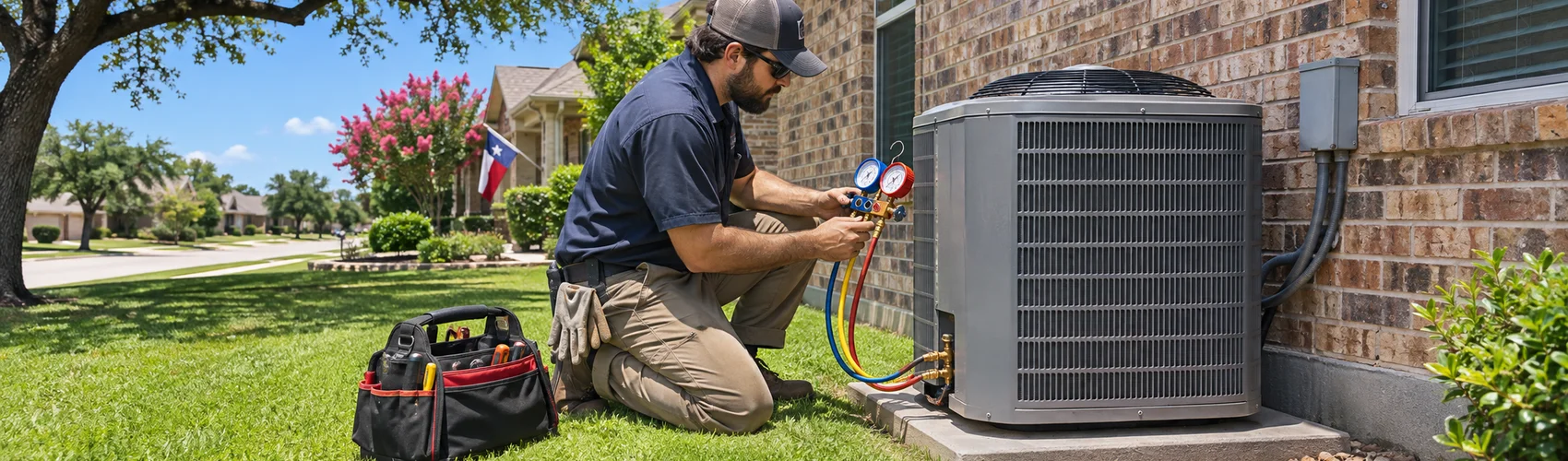
It is a July afternoon in McKinney. The thermostat says 74, but the house feels like 82. The AC is running, air is coming out of the vents, but it is not cold. By evening the upstairs bedrooms are uncomfortable, and nobody is sleeping well.
This is one of the most common calls we get every summer. The cause ranges from a five-minute fix you can do yourself to a failed part that needs a technician. Knowing the difference saves you time, money and, sometimes, a compressor.
ClassicABC Heating & Air has more than 40 years of industry experience and repairs air conditioners across McKinney. Here are eight common reasons an AC runs but does not cool, starting with the ones you can safely check on your own.
1. The Thermostat Is Set Wrong
It sounds too simple, but thermostat settings cause a surprising number of no-cooling calls.
- Make sure the mode is set to cool, not heat, auto or off.
- Set the fan to auto. A fan set to on keeps blowing air even when the compressor is off, which feels like warm air from the vents.
- Set the temperature at least three degrees below the current room temperature.
- Replace the batteries if the display is dim, blank or flashing.
- Check whether a schedule, vacation mode or hold setting is overriding what you set.
Smart thermostats can also lose their Wi-Fi connection or reset after a power outage. If everything looks right and the system still is not cooling after 10 minutes, move on.
2. The Air Filter Is Clogged
A dirty filter is one of the most common reasons an AC struggles. It chokes airflow across the indoor coil, which reduces cooling. Over time, the coil can get so cold that it freezes, and a frozen coil cannot cool at all.
Pull the filter and hold it up to a light. If you cannot see light through it, replace it. In McKinney, with spring pollen, cottonwood fluff, dust and long summer run times, many homes need a new filter every one to three months. Homes with pets or recent construction may need one every month.
3. The Outdoor Unit Is Dirty or Blocked
The outdoor condenser releases the heat your AC removes from the house. When its coil is covered in dirt, grass clippings, leaves, cottonwood or dryer lint, it cannot release heat efficiently, and the system loses cooling capacity just when you need it most.
Here is how to help it safely:
- Turn off power at the outdoor disconnect and the breaker.
- Clear leaves and debris from around the unit.
- Gently rinse the coil with a garden hose from the inside out if you can do so without opening the unit. Never use a pressure washer, which can bend the fins.
- Trim plants and shrubs to leave about two feet of clearance on all sides.
Do not open the electrical panel on the outdoor unit. The capacitor can hold a charge even with the power off.
4. The Breaker Tripped
If the indoor fan runs but the outdoor unit is silent, check the breaker panel. The outdoor condenser usually has its own breaker, often labeled AC or condenser.
You can reset a tripped breaker once. If it trips again, stop and call a technician. A breaker that keeps tripping points to an electrical problem or a compressor that is struggling to start, and repeated resets can make the damage worse.
5. The Evaporator Coil Is Frozen
Ice on the copper refrigerant lines near the outdoor unit or on the indoor coil means the system cannot cool. You may also see water dripping as the ice melts.
If you see ice:
- Turn the cooling off at the thermostat.
- Set the fan to on to help the coil thaw.
- Replace the air filter.
- Wait several hours for the ice to melt completely before turning the cooling back on.
If the coil freezes again, the cause is likely low refrigerant, a weak blower motor or an airflow problem in the ductwork. Those need a technician.
6. Low Refrigerant From a Leak
Refrigerant circulates in a closed loop. It does not get used up like fuel. If the system is low, there is a leak somewhere.
Signs of low refrigerant include:
- Ice on the refrigerant lines or indoor coil
- A hissing or bubbling sound near the indoor or outdoor unit
- An AC that runs constantly without reaching the setpoint
- Higher electric bills
- Air from the vents that is cool but not cold
A technician should find and repair the leak, not just add refrigerant. Adding refrigerant without fixing the leak means you will be paying for the same problem again. On older systems that use R-22, a phased-out refrigerant, a major leak often makes replacement the better choice.
7. A Failed Capacitor or Contactor
The capacitor gives the compressor and fan motor the boost they need to start. The contactor is the switch that turns the outdoor unit on when the thermostat calls for cooling. Both are among the most common summer failures in North Texas, because heat accelerates their wear.
Signs of a failed capacitor include an outdoor unit that hums but does not start, a fan that does not spin, or a fan that starts only if pushed. A worn contactor can keep the outdoor unit from turning on at all, or keep it running when it should be off.
These parts are usually quick and inexpensive for a technician to replace, but they should not be handled by homeowners because of the stored electrical charge.
8. Leaky or Undersized Ductwork
If the equipment is working but some rooms never cool, the problem may be in the ducts. In most McKinney homes, ductwork runs through the attic, where summer temperatures can climb well above 130 degrees.
Leaky, crushed or disconnected ducts lose cool air before it reaches the vents and can pull hot attic air into the system. Ducts that are too small for the system restrict airflow. A technician can measure airflow and inspect the attic to find where the cooling is being lost.
Questions to Ask Your AC Technician
- What is the temperature drop across the indoor coil?
- Is there a refrigerant leak, and where is it?
- Are the capacitor and contactor in good shape?
- Is my ductwork losing air in the attic?
- Is my system sized correctly for my home?
- How much life does my AC likely have left?
When to Turn the AC Off and Call
Shut the system off and call for service if you notice:
- Ice on the refrigerant lines or indoor coil
- Grinding, screeching or loud buzzing from the outdoor unit
- A burning or electrical smell
- A breaker that trips again after one reset
- Water overflowing from the indoor unit or staining the ceiling
Running the AC in these conditions can damage the compressor, which is the most expensive part of the system.
Why McKinney ACs Struggle in Summer
Long Stretches of Triple-Digit Heat
When afternoon temperatures stay near 100 degrees for days, the AC runs almost nonstop, and any weak part shows itself.
Hot Attics
Air handlers and ducts in the attic face extreme heat, which stresses drain lines, duct connections and electrical parts.
Pollen and Cottonwood
Spring pollen and cottonwood fluff mat outdoor coils and clog filters faster than many homeowners expect.
Older Systems in Established Neighborhoods
Many homes have systems that are 15 years old or more, and some still use R-22 refrigerant.
Get AC Repair in McKinney From ClassicABC
If you have checked the basics and your AC still is not cooling, ClassicABC Heating & Air can help. We find the cause, explain it clearly and give you the price before any work begins.
- Clear diagnosis: We find the cause before recommending a fix.
- Upfront pricing: You approve the scope and price before work begins.
- Savings: 10% off for veterans, senior citizens and teachers on eligible services, plus financing for eligible customers through Synchrony.
Call 214-310-2665 or schedule online. You can also learn more about our AC repair services in McKinney.
Frequently Asked Questions About AC Not Cooling in McKinney, TX
Why is my AC running but the house is not cooling?
Common causes include a dirty filter, a dirty outdoor coil, a frozen coil, low refrigerant or a failed capacitor.
How much cooler should the air from my vents be?
Air from the vents is usually about 15 to 20 degrees cooler than the air going into the return.
Can I add refrigerant myself?
No. Refrigerant work requires certification, and low refrigerant means there is a leak to repair.
Why is my AC not keeping up on very hot days?
Most systems are designed to hold about 20 degrees below the outdoor temperature. On 105-degree days, a dirty coil or weak part makes it even harder.
How long does it take to thaw a frozen AC?
Usually several hours with the cooling off and the fan on. Do not chip at the ice.