Schedule a Service


It is 5 p.m. in late July, the house is getting warmer by the minute and the thermostat says the system is running. Before you assume the worst, it is worth spending ten minutes on a few simple checks. A surprising number of “broken” HVAC systems turn out to be a tripped switch, a clogged filter or a thermostat setting that someone changed. And when the problem is real, what you learn from these checks helps the technician find it faster.
Here are six safe checks McKinney homeowners can do before calling for HVAC repair, plus the signs that mean it is time to stop checking and call a professional.
1. Confirm the Thermostat Is Really Asking for Air
Start where the system takes its orders.
- Make sure the mode is set to Cool or Heat, not Off or Fan.
- Set the temperature at least three degrees past the current room temperature.
- Replace the batteries if the display is dim, blank or flashing.
- Check whether a schedule or “hold” setting is overriding what you set.
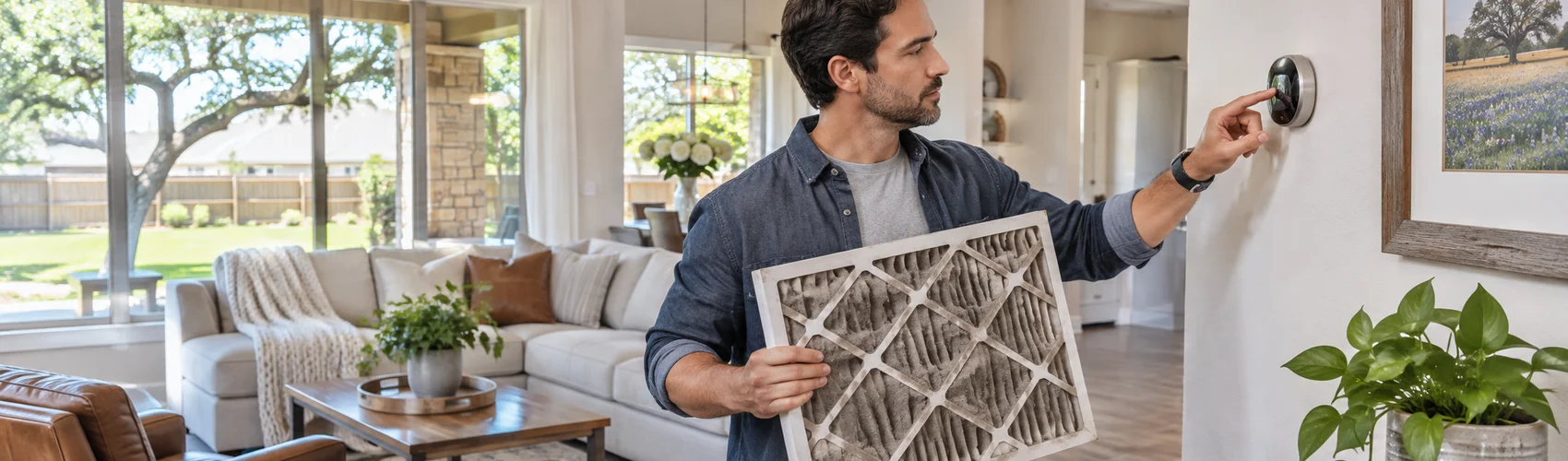
Smart thermostats can also lose Wi-Fi or reset after a power blip. If the display looks normal and the system still does nothing after five minutes, move on.
2. Look at the Air Filter
A badly clogged filter is one of the most common reasons an HVAC system struggles. It starves the system of air, which can make an air conditioner freeze up or a furnace overheat and shut itself off.
Pull the filter out and hold it up to a light. If you cannot see light through it, replace it. During McKinney’s spring pollen season and long summer run times, filters can load up faster than the package suggests.
3. Check the Breakers and the Furnace Switch
Your HVAC system usually has at least two breakers: one for the outdoor unit and one for the indoor unit. There is also often a light-switch-style power switch near the furnace or air handler.
- Make sure the indoor unit switch is on.
- Check the breaker panel for tripped HVAC breakers.
- If a breaker is tripped, you can reset it once.
If it trips again, stop. A breaker that keeps tripping is a safety device doing its job. Repeated resets can damage the compressor or create an electrical hazard.
4. Look for Water and a Tripped Float Switch
Most McKinney homes have the air handler in the attic, with a drain pan underneath and a condensate line that carries water outside. When that line clogs, a float switch can shut the system off to prevent an overflow.
Signs this is the issue:
- Water in the secondary drain pan
- Water dripping from a pipe near your eaves or above a window
- A small float switch on the drain line or pan that is lifted
If you see water, turn the system off and call. Clearing the drain is quick for a technician, and it protects your ceiling.
5. Walk Out to the Outdoor Unit
With the system calling for cooling, go outside and look and listen.
- Fan not spinning but the unit hums: often a capacitor or fan motor problem.
- Nothing running at all: possibly a tripped breaker, disconnect or control issue.
- Coil covered in cottonwood, grass or leaves: gently rinse it with a garden hose from the inside out if you can do so without opening the unit.
- Ice on the copper lines: turn the system off and let it thaw before the technician arrives.
Do not open the electrical panel on the outdoor unit. The capacitor can hold a charge even with power off.
6. Check the Vents and Returns
Walk through the house and make sure supply vents are open and return grilles are not blocked by furniture, rugs or curtains. Closing too many vents raises pressure in the ductwork and can reduce comfort across the whole house.
If one or two rooms are much warmer than the rest while the system runs normally, the problem may be in the ducts rather than the equipment, such as a disconnected or crushed duct in the attic.
When to Stop Troubleshooting and Call
Call for HVAC repair right away if you notice any of the following:
- A burning, electrical or gas smell
- A breaker that trips again after one reset
- Ice on the refrigerant lines or indoor coil
- Water overflowing near the indoor unit or staining the ceiling
- Grinding, screeching or banging from either unit
- A carbon monoxide alarm (leave the home and call 911 first)
- The house temperature climbing steadily on a very hot day
Why McKinney Homes See These Problems
Long Cooling Seasons
North Texas air conditioners often run from April into October. Parts like capacitors and contactors wear faster when the system rarely rests.
Hot Attics
With the air handler and ducts in the attic, summer heat stresses drain lines, duct connections and equipment. Many two-story homes in neighborhoods like Stonebridge Ranch, Eldorado and Craig Ranch also have a second system up there.
Pollen and Cottonwood
Spring pollen and cottonwood fluff can mat outdoor coils and load filters quickly.
Sudden Freezes
When temperatures drop sharply, furnaces and heat pumps that sat idle for months are suddenly asked to run hard, which reveals weak igniters, sensors and defrost controls.
What Your Technician Will Check
When you call for HVAC repair, a technician typically checks:
- Thermostat and low-voltage controls
- Electrical components such as capacitors, contactors and motors
- Refrigerant pressures and temperature split
- Airflow, filter and blower condition
- Condensate drain, pan and float switch
- For heating: ignition, flame sensing, venting and safety switches
Tell the technician what you already checked. It saves time and points them in the right direction.
Get HVAC Repair in McKinney From ClassicABC
If your checks did not solve the problem, or you saw one of the warning signs above, ClassicABC Heating & Air can help. Our team brings over 40 years of industry experience to McKinney homes, from historic houses near the downtown square to newer neighborhoods along SH-121 and US-380.
- Clear diagnosis: We find the cause before recommending a fix.
- Upfront pricing: You approve the scope and price before work begins.
- Savings: 10% off for veterans, senior citizens and teachers on eligible services, plus financing for eligible customers.
Call 214-310-2665 or schedule your HVAC repair online. You can also learn more about our AC repair in McKinney and heating repair in McKinney.
Frequently Asked Questions About HVAC Repair in McKinney, TX
Is it safe to reset my HVAC breaker?
You can reset it once. If it trips again, leave it off and call for repair.
Why is my AC running but not cooling?
Common causes include a dirty filter, a failed capacitor, low refrigerant or an outdoor unit that is not running.
Why is water dripping from a pipe outside my house?
That is often the secondary drain line, which means the primary drain may be clogged.
Can I fix a frozen AC myself?
You can turn the system off to let it thaw and replace a dirty filter, but the cause should be diagnosed by a technician.
How often should my HVAC be serviced?
Once a year for each season is common: spring for cooling and fall for heating.