Schedule a Service


Most McKinney homeowners only think about their heating and air conditioning when something feels off. A bedroom upstairs will not cool below 80. The furnace smells dusty on the first cold night of November. The electric bill for August is noticeably higher than last year's. When you book an HVAC service call, you are trusting a stranger to look at one of the most expensive systems in your home and tell you what it needs.
It helps to know what a complete visit looks like. A thorough technician checks the whole system, explains what they found and gives you options. A rushed one glances at the thermostat, adds refrigerant and leaves. The difference shows up months later, usually on the hottest day of the year.
At ClassicABC Heating & Air, our team has more than 40 years in the industry, and we serve McKinney homes from our base in Plano. Here are seven things a good HVAC service visit should cover, plus the questions worth asking while the technician is there.
1. A Conversation Before the Tools Come Out
A good technician starts by asking questions, not by opening panels. When did the problem start? Is it every room or just one? Does it happen in the afternoon, at night or all day? Did anything change recently, like a power outage, a new thermostat or a remodel? When was the filter last changed?
Your answers narrow down the possibilities faster than any gauge. An AC that struggles only in the late afternoon points to a different problem than one that never shuts off. A furnace that short cycles after a filter change points somewhere else entirely. If the technician skips this step, they are guessing.
Before the visit, it helps to jot down what you have noticed: sounds, smells, which rooms are affected and roughly when it started. Even small details, like a breaker that tripped last week, can save diagnostic time.
2. A Thermostat and Airflow Check
Many comfort complaints start at the thermostat or the filter, so a thorough visit checks both early.
The technician should confirm the thermostat is set correctly, that it is reading the room temperature accurately and that it is actually calling for heating or cooling. Thermostats mounted on a sunny wall or near a supply vent can read wrong and run the system too long or too little. Smart thermostats sometimes lose their schedule or Wi-Fi connection after a power blip.
Next comes the filter. A clogged filter can make an air conditioner freeze up, make a furnace overheat and trip its safety switch, and push dust into the rest of the system. The technician should check the filter's size, type and condition and tell you how often to change it based on your household, pets and the season.
3. An Outdoor Unit Inspection
For cooling, the outdoor condenser does the heavy lifting. Its job is to release the heat pulled out of your home, and in McKinney summers, when afternoon temperatures stay near 100 degrees for days at a time, it works very hard.
A thorough inspection includes:
- Checking the condenser coil for dirt, grass clippings, cottonwood fluff and debris
- Testing the capacitor, which helps the compressor and fan motor start
- Inspecting the contactor for pitting or burn marks
- Listening to the compressor and fan motor for unusual noise
- Looking at the refrigerant line insulation and the electrical disconnect
A dirty condenser coil is one of the most common reasons an AC cannot keep up in July. A weak capacitor is one of the most common summer failures in North Texas, and catching it early can prevent a no-cooling call later.
4. An Indoor Unit Inspection
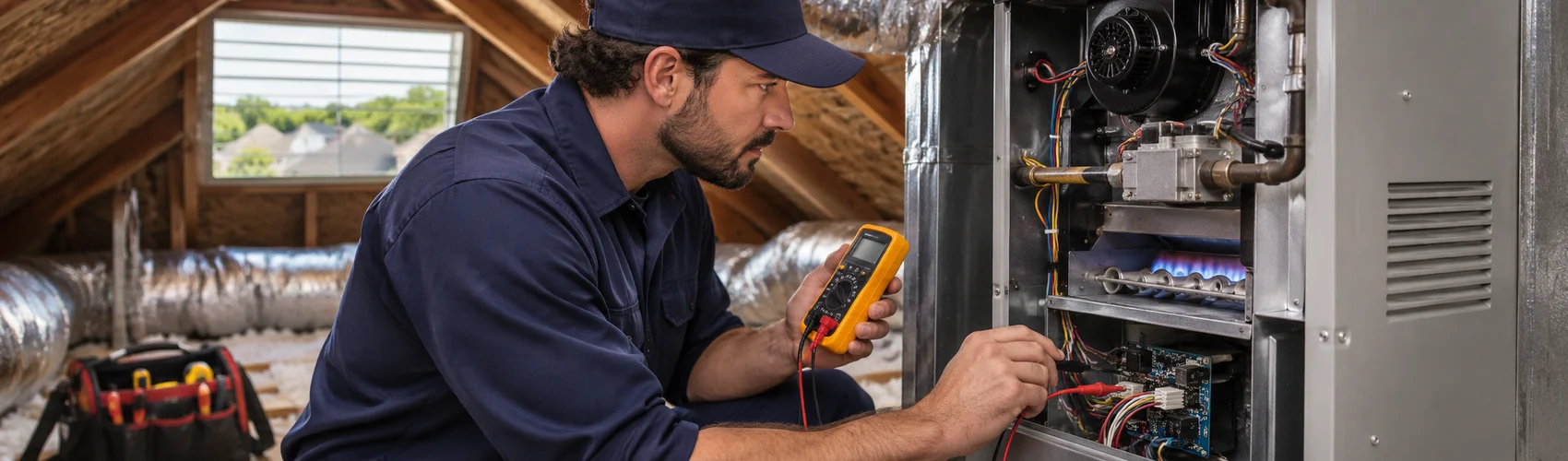
Inside the house, the technician should look at the parts you rarely see. On most McKinney homes, that means climbing into the attic, where the air handler or furnace often sits above the living space.
For cooling, that includes the evaporator coil, the blower motor and wheel, and the condensate drain line and pan. A clogged condensate line is a frequent cause of water stains on ceilings in attic installations, and a working float switch is what shuts the system off before that happens.
For heating, the technician should check the burners, igniter, flame sensor, heat exchanger, venting and safety switches on a gas furnace, or the heat strips and defrost controls on a heat pump. If you have a gas furnace, the visit is also a good time to confirm that your carbon monoxide detectors work.
5. Measurements, Not Guesses
A thorough visit includes real numbers. Depending on the problem, the technician may measure:
- Temperature drop across the indoor coil, which shows whether the AC is cooling as designed
- Refrigerant pressures and superheat or subcooling, when there is reason to suspect a charge problem
- Voltage and amperage on motors and the compressor
- Capacitor readings compared with their rated values
- Static pressure in the ductwork, when airflow is in question
Measurements confirm the cause and show you why a repair is being recommended. Be cautious of any visit where refrigerant is added without a measurement or without discussing where the refrigerant went. Refrigerant does not get used up; if it is low, there is a leak.
6. A Clear Explanation and Price Before Work Begins
Once the cause is found, you should hear three things: what failed, why it failed and what your options are. You should also see the price before any repair starts.
If the system is older and repairs are adding up, a good technician will talk honestly about repair versus replacement. That does not mean pushing a new system. It means laying out the age of the equipment, the cost of the current repair and what is likely to fail next, so you can decide with full information.
7. A Final Test and Summary
After the repair, the system should run through a full heating or cooling cycle while the technician confirms it is working properly. The temperature at the vents, the sound of the equipment and the drain should all be checked before they leave.
You should also get a short summary: what was done, anything else worth watching, and when the system should be serviced next. If a part is wearing but not failed yet, you should hear about it so it does not surprise you later.
Questions to Ask During Your HVAC Service Visit
- What exactly caused the problem?
- Is this a one-time failure or a sign of wear elsewhere?
- How old is my system, and how much life does it likely have left?
- Were the capacitor, contactor and condensate drain checked?
- Is there anything I can do to prevent this from happening again?
- Would a maintenance plan make sense for my system?
When to Schedule HVAC Service in McKinney
Spring and fall are the best times for routine service, before the heavy cooling and heating seasons start. Technicians have more availability, and any problems found can be fixed before you depend on the system every day.
Do not wait for a scheduled visit if you notice any of these:
- Warm air from the vents while the AC is running
- Short cycling, where the system turns on and off every few minutes
- Ice on the refrigerant lines or the outdoor unit
- Water around the indoor unit or stains on the ceiling below it
- Burning smells or grinding, screeching or banging noises
- A sudden jump in your energy bill without a change in weather
If you ever smell gas near your furnace, leave the home and call your gas utility or 911 from outside.
Why McKinney Homes Need Regular HVAC Service
Long Cooling Seasons
Air conditioners in North Texas often run from April into October. Parts like capacitors, contactors and fan motors wear faster when the system rarely rests.
Attic Equipment
Most McKinney homes have the air handler and ductwork in the attic, where summer heat stresses drain lines, duct connections and electrical parts.
Pollen and Cottonwood
Spring pollen and cottonwood fluff mat outdoor coils and load filters quickly, especially in neighborhoods with mature trees.
Sudden Cold Snaps
Furnaces and heat pumps that sit idle for months are suddenly asked to run hard when a norther blows through, which reveals weak igniters, sensors and defrost controls.
Get HVAC Service in McKinney From ClassicABC
Whether your AC is struggling or your furnace is acting up, ClassicABC Heating & Air will find the cause and explain your options before any work begins. We serve homes across McKinney, from historic houses near the downtown square to newer neighborhoods along SH-121 and US-380.
- Clear diagnosis: We find the cause before recommending a fix.
- Upfront pricing: You approve the scope and price before work begins.
- Savings: 10% off for veterans, senior citizens and teachers on eligible services, plus financing for eligible customers through Synchrony.
Call 214-310-2665 or schedule online. You can also learn more about our heating and air conditioning services in McKinney.
Frequently Asked Questions About HVAC Service in McKinney, TX
How often should I get HVAC service in McKinney?
Twice a year is a good rule: cooling service in spring and heating service in fall.
How long does an HVAC service call take?
Most visits take one to two hours, depending on the problem, the system and how easy the equipment is to reach.
Do you service both heating and cooling systems?
Yes. ClassicABC services air conditioners, gas and electric furnaces, heat pumps and ductless systems.
Why does my technician need to go into the attic?
In most McKinney homes, the furnace or air handler, the indoor coil and the condensate drain are in the attic, and many problems start there.
Should refrigerant be added at every service visit?
No. A properly working system does not lose refrigerant. If it is low, the leak should be found and repaired.